What Type of Food Additive Is Used to Prevent Separation?
17.7: Other Food Additives- Beneficial or Dangerous
- Page ID
- 351347
Learning Objective
- Know the purpose of other ingredients added to food.
For centuries, ingredients have served useful functions in a variety of foods. Our ancestors used table salt to preserve meats and fish, added herbs and spices to improve the flavour of foods, preserved fruit with sugar, and pickled cucumbers in a vinegar solution. Today, consumers demand and relish a nutrient supply that is flavorful, nutritious, safe, convenient, colorful and affordable. Food additives and advances in engineering help make that possible.
In that location are thousands of ingredients used to make foods. The Food and Drug Assistants (FDA) maintains a list of over 3000 ingredients in its data base "Everything Added to Food in the United States", many of which nosotros use at abode every mean solar day (eastward.g., sugar, baking soda, salt, vanilla, yeast, spices and colors).
Yet, some consumers accept concerns most additives because they may come across the long, unfamiliar names and think of them as complex chemical compounds. In fact, every nutrient we eat - whether a just-picked strawberry or a homemade cookie - is made up of chemical compounds that determine flavor, color, texture and nutrient value. All nutrient additives are carefully regulated by federal authorities and various international organizations to ensure that foods are safe to consume and are accurately labeled.
Additives perform a variety of useful functions in foods that consumers often take for granted. Some additives could be eliminated if we were willing to grow our own food, harvest and grind information technology, spend many hours cooking and canning, or accept increased risks of food spoilage. Only nigh consumers today rely on the many technological, aesthetic and convenient benefits that additives provide.
Following are some reasons why ingredients are added to foods:
- To Maintain or Improve Safety and Freshness: Preservatives dull product spoilage caused by mold, air, leaner, fungi or yeast. In addition to maintaining the quality of the food, they help control contamination that tin cause foodborne affliction, including life-threatening botulism. Ane group of preservatives -- antioxidants -- prevents fats and oils and the foods containing them from becoming rancid or developing an off-flavor. They also prevent cutting fresh fruits such as apples from turning brown when exposed to air.
- To Improve or Maintain Nutritional Value: Vitamins and minerals (and cobweb) are added to many foods to brand up for those lacking in a person's diet or lost in processing, or to enhance the nutritional quality of a food. Such fortification and enrichment has helped reduce malnutrition in the U.S. and worldwide. All products containing added nutrients must exist appropriately labeled.
- Improve Gustatory modality, Texture and Appearance: Spices, natural and artificial flavors, and sweeteners are added to enhance the taste of food. Nutrient colors maintain or improve advent. Emulsifiers, stabilizers and thickeners give foods the texture and consistency consumers await. Leavening agents let baked goods to ascent during baking. Some additives assist control the acerbity and alkalinity of foods, while other ingredients assist maintain the gustation and appeal of foods with reduced fat content.
Types of Food Ingredients
The following summary lists the types of common nutrient ingredients, why they are used,
and some examples of the names that can be found on product labels. Some additives are
used for more ane purpose.
| Types of Ingredients | What They Do | Examples of Uses | Names Establish on Production Labels |
|---|---|---|---|
| Preservatives | Prevent food spoilage from leaner, molds, fungi, or yeast (antimicrobials); slow or foreclose changes in color, flavor, or texture and delay rancidity (antioxidants); maintain freshness | Fruit sauces and jellies, beverages, baked appurtenances, cured meats, oils and margarines, cereals, dressings, snack foods, fruits and vegetables | Ascorbic acrid, citric acrid, sodium benzoate, calcium propionate, sodium erythorbate, sodium nitrite, calcium sorbate, potassium sorbate, BHA, BHT, EDTA, tocopherols (Vitamin E) |
| Sweeteners | Add sweetness with or without the extra calories | Beverages, baked appurtenances, confections, table-top sugar, substitutes, many processed foods | Sucrose (sugar), glucose, fructose, sorbitol, mannitol, corn syrup, loftier fructose corn syrup, saccharin, aspartame, sucralose, acesulfame potassium (acesulfame-Thou), neotame |
| Color Additives | Offset color loss due to exposure to light, air, temperature extremes, wet and storage conditions; correct natural variations in colour; enhance colors that occur naturally; provide colour to colorless and "fun" foods | Many processed foods, (candies, snack foods margarine, cheese, soft drinks, jams/jellies, gelatins, pudding and pie fillings) | FD&C Blue Nos. 1 and 2, FD&C Light-green No. 3, FD&C Blood-red Nos. 3 and 40, FD&C Yellowish Nos. v and six, Orange B, Citrus Red No. 2, annatto extract, beta-carotene, grape skin extract, cochineal excerpt or ruby-red, paprika oleoresin, caramel colour, fruit and vegetable juices, saffron (Note: Exempt color additives are not required to be declared by name on labels but may be declared simply as colorings or color added) |
| Flavors and Spices | Add together specific flavors (natural and synthetic) | Pudding and pie fillings, gelatin dessert mixes, block mixes, salad dressings, candies, soft drinks, ice foam, BBQ sauce | Natural flavoring, artificial flavor, and spices |
| Flavor Enhancers | Enhance flavors already nowadays in foods (without providing their own split season) | Many processed foods | Monosodium glutamate (MSG), hydrolyzed soy protein, autolyzed yeast extract, disodium guanylate or inosinate |
| Fat Replacers (and components of formulations used to supervene upon fats) | Provide expected texture and a flossy "mouth-feel" in reduced-fat foods | Baked goods, dressings, frozen desserts, confections, cake and dessert mixes, dairy products | Olestra, cellulose gel, carrageenan, polydextrose, modified food starch, microparticulated egg white poly peptide, guar gum, xanthan glue, whey protein concentrate |
| Nutrients | Supplant vitamins and minerals lost in processing (enrichment), add nutrients that may be lacking in the diet (fortification) | Flour, breads, cereals, rice, macaroni, margarine, salt, milk, fruit beverages, energy bars, instant breakfast drinks | Thiamine hydrochloride, riboflavin (Vitamin Btwo), niacin, niacinamide, folate or folic acid, beta carotene, potassium iodide, iron or ferrous sulfate, blastoff tocopherols, ascorbic acid, Vitamin D, amino acids (L-tryptophan, L-lysine, 50-leucine, L-methionine) |
| Emulsifiers | Let polish mixing of ingredients, prevent separation Proceed emulsified products stable, reduce stickiness, control crystallization, keep ingredients dispersed, and to help products dissolve more easily | Salad dressings, peanut butter, chocolate, margarine, frozen desserts | Soy lecithin, mono- and diglycerides, egg yolks, polysorbates, sorbitan monostearate |
| Stabilizers and Thickeners, Binders, Texturizers | Produce uniform texture, improve "oral fissure-feel" | Frozen desserts, dairy products, cakes, pudding and gelatin mixes, dressings, jams and jellies, sauces | Gelatin, pectin, guar gum, carrageenan, xanthan mucilage, whey |
| pH Control Agents and acidulants | Control acerbity and alkalinity, prevent spoilage | Beverages, frozen desserts, chocolate, low acid canned foods, baking pulverization | Lactic acid, citric acrid, ammonium hydroxide, sodium carbonate |
| Leavening Agents | Promote rising of baked appurtenances | Breads and other baked goods | Blistering soda, monocalcium phosphate, calcium carbonate |
| Anti-caking agents | Keep powdered foods gratis-flowing, forestall moisture assimilation | Table salt, baking powder, confectioner'south sugar | Calcium silicate, iron ammonium citrate, silicon dioxide |
| Humectants | Retain moisture | Shredded kokosnoot, marshmallows, soft candies, confections | Glycerin, sorbitol |
| Yeast Nutrients | Promote growth of yeast | Breads and other broiled goods | Calcium sulfate, ammonium phosphate |
| Dough Strengtheners and Conditioners | Produce more stable dough | Breads and other baked goods | Ammonium sulfate, azodicarbonamide, L-cysteine |
| Firming Agents | Maintain crispness and firmness | Processed fruits and vegetables | Calcium chloride, calcium lactate |
| Enzyme Preparations | Modify proteins, polysaccharides and fats | Cheese, dairy products, meat | Enzymes, lactase, papain, rennet, chymosin |
| Gases | Serve equally propellant, aerate, or create carbonation | Oil cooking spray, whipped cream, carbonated beverages | Carbon dioxide, nitrous oxide |
Antioxidants: BHA and BHT
Antioxidants are used as nutrient additives to help guard confronting food deterioration . Exposure to oxygen and sunlight are the two primary factors in the oxidation of nutrient, then food is preserved by keeping in the night and sealing it in containers or even coating information technology in wax, every bit with cucumbers. However, as oxygen is likewise of import for plant respiration , storing institute materials in anaerobic conditions produces unpleasant flavors and unappealing colors. Consequently, packaging of fresh fruits and vegetables contains an ~8% oxygen atmosphere. Antioxidants are an particularly of import class of preservatives every bit, dissimilar bacterial or fungal spoilage, oxidation reactions however occur relatively rapidly in frozen or refrigerated food. [162] These preservatives include natural antioxidants such every bit ascorbic acid (AA) and tocopherols , equally well as constructed antioxidants such as propyl gallate , tertiary butylhydroquinone (TBHQ), butylated hydroxyanisole (BHA) and butylated hydroxytoluene (BHT).
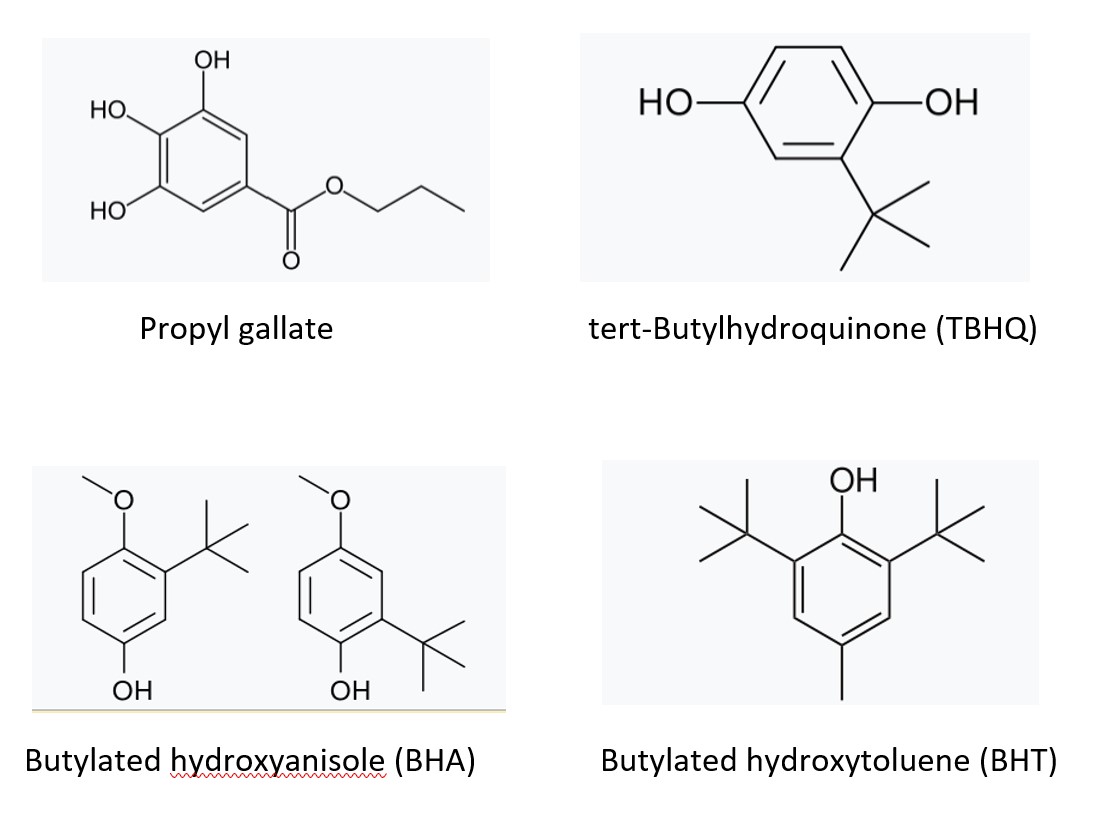
Figure \(\PageIndex{one}\) Constructed antioxidants . Source Wikipedia
The most mutual molecules attacked by oxidation are unsaturated fats; oxidation causes them to plough rancid . Since oxidized lipids are frequently discolored and usually have unpleasant tastes such as metallic or sulfurous flavors, it is important to avoid oxidation in fatty-rich foods. Thus, these foods are rarely preserved past drying; instead, they are preserved by smoking , salting or fermenting . Fifty-fifty less fatty foods such as fruits are sprayed with sulfurous antioxidants prior to air drying. Oxidation is often catalyzed past metals, which is why fats such as butter should never exist wrapped in aluminium foil or kept in metal containers. Some fatty foods such equally olive oil are partially protected from oxidation past their natural content of antioxidants, but remain sensitive to photooxidation.
Color Additives
A color condiment is any dye, pigment or substance which when added or applied to a food, drug or cosmetic, or to the human body, is capable (alone or through reactions with other substances) of imparting color. FDA is responsible for regulating all color additives to ensure that foods containing colour additives are condom to eat, incorporate only approved ingredients and are accurately labeled.
Colour additives are used in foods for many reasons: 1) to offset colour loss due to exposure to lite, air, temperature extremes, moisture and storage weather condition; 2) to right natural variations in color; 3) to enhance colors that occur naturally; and 4) to provide color to colorless and "fun" foods. Without color additives, colas wouldn't be brown, margarine wouldn't be yellowish and mint ice cream wouldn't be light-green. Color additives are now recognized as an important part of practically all processed foods nosotros eat.
US FDA'southward permitted colors are classified as subject to certification or exempt from certification , both of which are subject to rigorous safety standards prior to their blessing and list for employ in foods.
- Certified colors are synthetically produced (or human made) and used widely because they impart an intense, uniform color, are less expensive, and blend more easily to create a variety of hues. There are nine certified color additives approved for utilise in the United States (e.chiliad., FD&C Xanthous No. 6. Encounter chart for complete listing .). Certified food colors generally practise non add undesirable flavors to foods.
- Colors that are exempt from certification include pigments derived from natural sources such every bit vegetables, minerals or animals. Nature derived color additives are typically more than expensive than certified colors and may add unintended flavors to foods. Examples of exempt colors include annatto extract (yellow), dehydrated beets (bluish-red to brown), caramel (yellow to tan), beta-carotene (yellow to orangish) and grape pare extract (ruby, dark-green).
- In the United States, FD&C numbers (which indicate that the FDA has approved the colorant for employ in foods, drugs and cosmetics ) are given to approved synthetic food dyes that do not be in nature, while in the European Union, E numbers are used for all additives, both synthetic and natural, that are approved in food applications.
Bogus Food Colors
In the US, the following seven artificial colorings are mostly permitted in food (the well-nigh common in bold) as of 2016. The lakes of these colorings are also permitted except the lake of Ruby No. 3. [23]
- FD&C Blue No. 1 – Brilliant Blue FCF , E133 (blue shade)
- FD&C Blue No. two – Indigotine , E132 ( indigo shade)
- FD&C Green No. iii – Fast Green FCF , E143 (turquoise shade)
- FD&C Ruddy No. three – Erythrosine , E127 (pink shade, commonly used in glacé cherries ) [24]
- FD&C Red No. twoscore – Allura Ruby AC , E129 (red shade)
- FD&C Yellow No. five – Tartrazine , E102 (yellow shade)
- FD&C Yellow No. 6 – Sunset Yellow FCF , E110 (orange shade)
Two dyes are immune by the FDA for express applications:
- Citrus Cherry two (orange shade) - allowed only to color orangish peels.
- Orange B (cherry shade) - immune merely for use in hot dog and sausage casings (not produced after 1978, only never delisted)
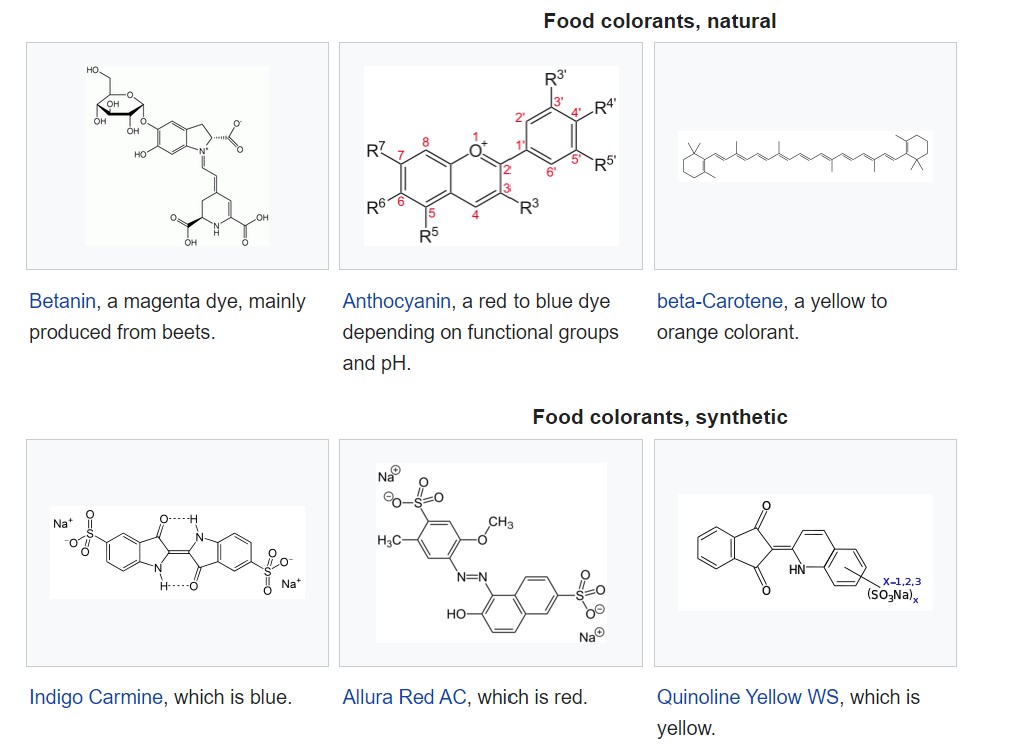
Figure \(\PageIndex{ii}\) Chemical Structures of representative colorants. Source: Wikipedia.
Natural nutrient dyes
Carotenoids , chlorophyllin , anthocyanins , and betanin contain 4 principal categories of plant pigments grown to color food products. [30] Other colorants or specialized derivatives of these core groups include:
- Annatto , a scarlet-orangish dye made from the seed of the achiote
- Caramel coloring , made from caramelized sugar
- Carmine , a crimson dye derived f rom the cochineal insect, Dactylopius coccus
- Elderberry juice
- Lycopene
- Paprika
- Turmeric

Figure \(\PageIndex{iii}\) Natural food colors can brand a variety of different hues. Source: Wikipedia
Blueish colors are specially rare. One viable blue dye currently in use is derived from spirulina . Some recent enquiry has explored associating anthocyanins with other phenolics or aluminium ions to develop bluish colours. However, the inherent issues posed past the nature of the food matrix, and the demand for long‐term stability, makes this a very hard objective. The pigment genipin , present in the fruit of Gardenia jasminoides , can exist treated with amino acids to produce the blueish paint gardenia bluish, which is canonical for utilize in Japan but non the European union or the U.s.a.. [32]
To ensure reproducibility, the colored components of these substances are oft provided in highly purified form. For stability and convenience, they can be formulated in suitable carrier materials (solid and liquids). Hexane , acetone , and other solvents break downwards cell walls in the fruit and vegetables and allow for maximum extraction of the coloring. Traces of these may still remain in the finished colorant, only they do not need to be alleged on the product characterization. These solvents are known as carry-over ingredients.
Summary
- Unlike ingredients are added to nutrient in social club to:
i. maintain or improve safety and freshness,
2. amend or maintain nutritional value, and
3. improve gustation, texture, and appearance.
- Mutual antioxidants added to foods include, ascorbic acid, tocopherols, propyl gallate, BHA, BHT, & TBHQ.
- There are seven artificial colorings that are generally permitted in the US. The most common ones are FD&C Blue No.ane, FD&C Ruby No. twoscore, FD&C Xanthous No.5, and FD&C Xanthous No.6.
Source: https://chem.libretexts.org/Courses/Sacramento_City_College/SCC%3A_CHEM_330_-_Adventures_in_Chemistry_(Alviar-Agnew)/17%3A_Food/17.07%3A_Other_Food_Additives-__Beneficial_or_Dangerous
0 Response to "What Type of Food Additive Is Used to Prevent Separation?"
Post a Comment